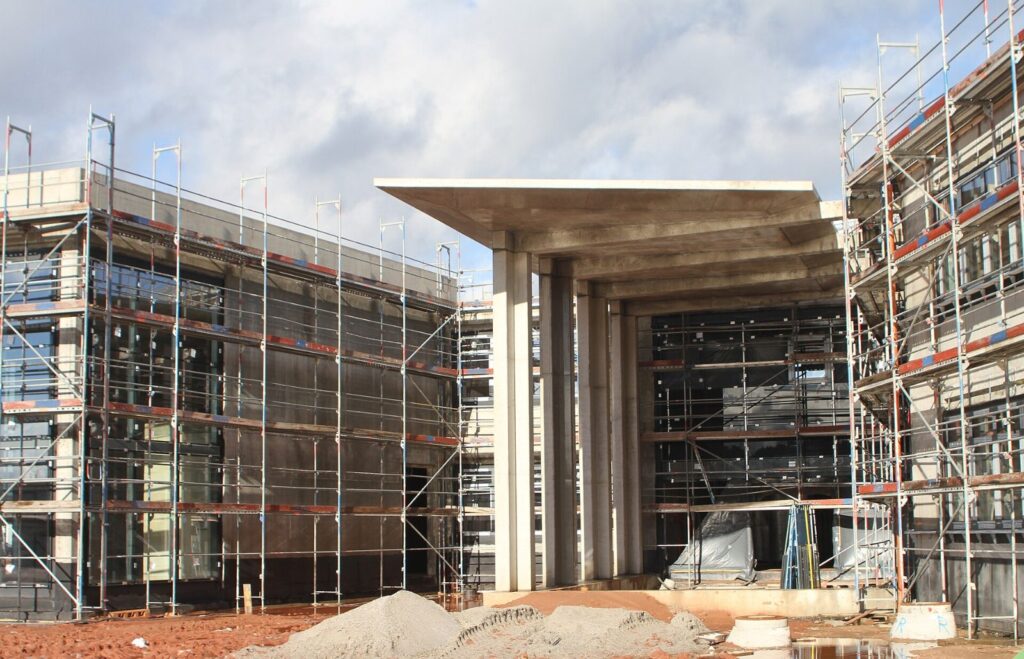
The short version
- Scanning a site at key milestones gives you a walkable record of every stage.
- The most valuable scan is just before walls and ceilings close: it records what’s hidden inside them.
- Teams, consultants and clients check progress remotely and visit only when they need to.
- The scans stay useful for years, from handover to maintenance.
01Why scan a construction site?
A construction site changes every week, and once a wall is closed, what’s inside it disappears from view for good.
Photos help, but they’re scattered across phones and hard to place. A 3D scan records the whole site as a walkable space, true to scale, on a known date. Anyone on the project can open it from a link and stand in any room as it was that day.
The idea is simple: capture the site at each important stage, keep every scan, and you have a visual history of the build [1].

02When to scan
There’s no single right schedule. Most projects scan at milestones, and busy sites sometimes scan weekly [1]. A simple plan that works for most buildings:
- Existing conditions
Before work starts, especially for renovations and fit-outs. It settles “was it like that before?” questions later.
- Structure complete
Frame, slabs and columns in place, before services go in.
- Before walls and ceilings close
The most valuable scan of all: pipes, cables, ducts and supports recorded exactly where they were installed.
- Finishes
Flooring, fittings and fixtures in, ready for snagging.
- Handover
The finished space, for the owner, the facility team and marketing.

03What it saves
Architects, consultants and head offices check progress remotely.
A dated, walkable record answers “what was there, and when?”
Find what’s behind a wall without opening it up.
Clients and investors see real progress, not just a percentage.
Construction technology companies increasingly connect 360° and 3D captures directly to project management tools, so progress records sit right next to schedules and issues [2].
Share your timeline. We’ll suggest the milestones worth capturing.
04Comparing progress with the design
When you also have the 3D design, you can put the approved model next to the site scan and spot differences early, while they’re still cheap to fix. That’s the idea behind our Create + Capture service, explained in design vs reality.
How precise is a scan for this kind of check? Good for spotting what’s missing or misplaced, not for millimetre tolerances. Our guide on how accurate a 3D scan is explains where the line sits.
05After handover, the scans keep working
The final scan becomes the building’s visual record. Facility teams use it to plan maintenance, onboard contractors and find equipment, as we explain in digital twins for maintenance and records. The “before walls close” scan becomes priceless the first time a leak or a cable needs tracing.
Planning a project? Our Capture service can scan on a schedule that matches your milestones. Each scan is delivered in 3–5 working days after the visit. See also our work across industrial and construction sites.
06Questions people ask
How often should a site be scanned?
There’s no single rule. Most projects scan at key milestones, like after structure, before walls and ceilings close, and at handover. Busy sites sometimes scan weekly.
Can scans replace site visits?
Not completely, but they cut many of them. Teams, consultants and clients can check progress remotely and visit only when needed.
Can different dates be compared?
Yes. Keeping scans from each milestone lets you see how the space changed over time.
Who keeps the scans?
You do. Each scan is a link and a record you can share with your team and keep for the building’s future.
Sources
- Matterport, The construction progress documentation playbook (a 3D capture company)
- Trimble, Embedded reality capture for construction progress monitoring
- Matterport, How to monitor construction work progress (a 3D capture company)
Image credits
- Photo: U.S. Army Corps of Engineers Europe District / Wikimedia Commons · Public domain
- Photo: U.S. Army Corps of Engineers Europe District / Wikimedia Commons · Public domain
- Photo: U.S. Air Force, Airman Synsere Howard / Wikimedia Commons · Public domain